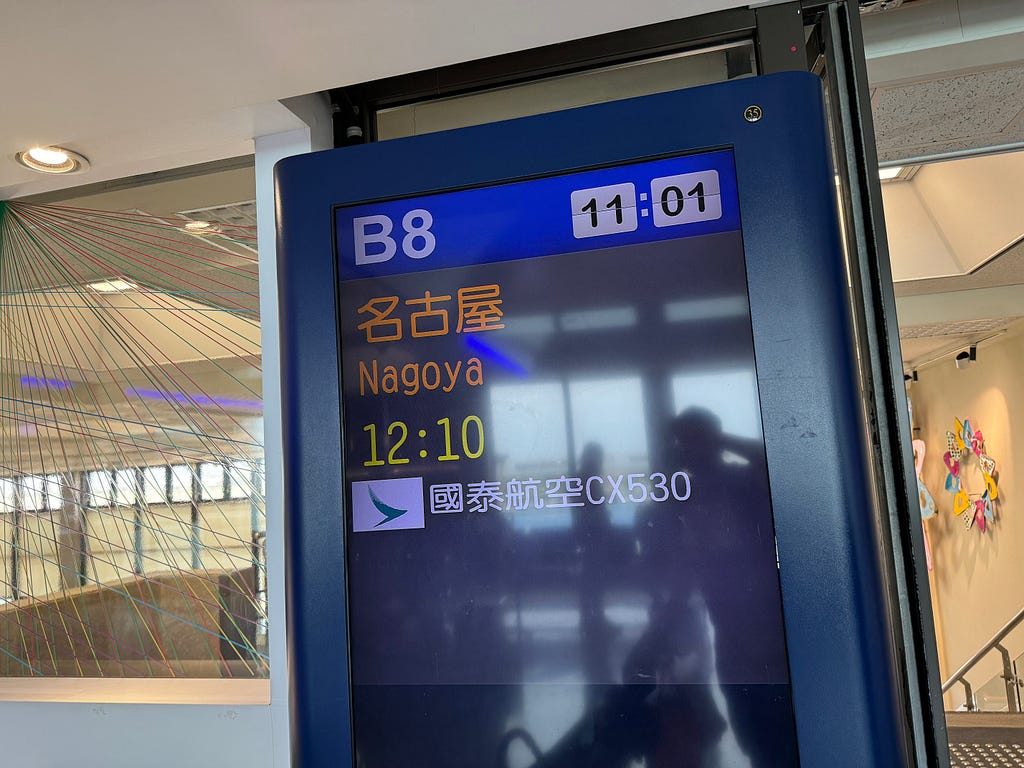
Just back from a work trip to the States, we squeezed in a family run to Nagoya before the summer travel crush hit. A week of leave plus the weekends on either end made nine days — the longest trip the three of us have done. Nagoya, north to Kamikochi, the Shirakawa-go gassho village, Kanazawa, then back to Nagoya. Travelling with a two-year-old is work, no argument, but my wife and I both love it. People say a kid this young won’t remember any of it. Maybe the sweet memory of travelling as a family was always a thing for the adults. What stuck with me: he can barely speak Mandarin yet, but when I said thank you to a shop clerk he started copying me. Different eyes on the world already, this early.
So it was a two-on-one trip again, itinerary built around the kid, schedule loose. The rods came along, but lean — and there was no plan for which day or hour I’d actually fish. Wait for the boy to sleep, wash the bottles, and if there was time, if there was a chance, maybe go fish.
Gear
The only coastal stops were Nagoya and Kanazawa; everything else sat inland in the mountains. There were trout and char up there, but two problems killed it — the areas I’d pass through have protected zones, and given the family situation the only fishable hours were deep night. The terrain needs to be easy underfoot in the dark, and the local river co-op rules ban night fishing outright. Trout was off the table this trip.
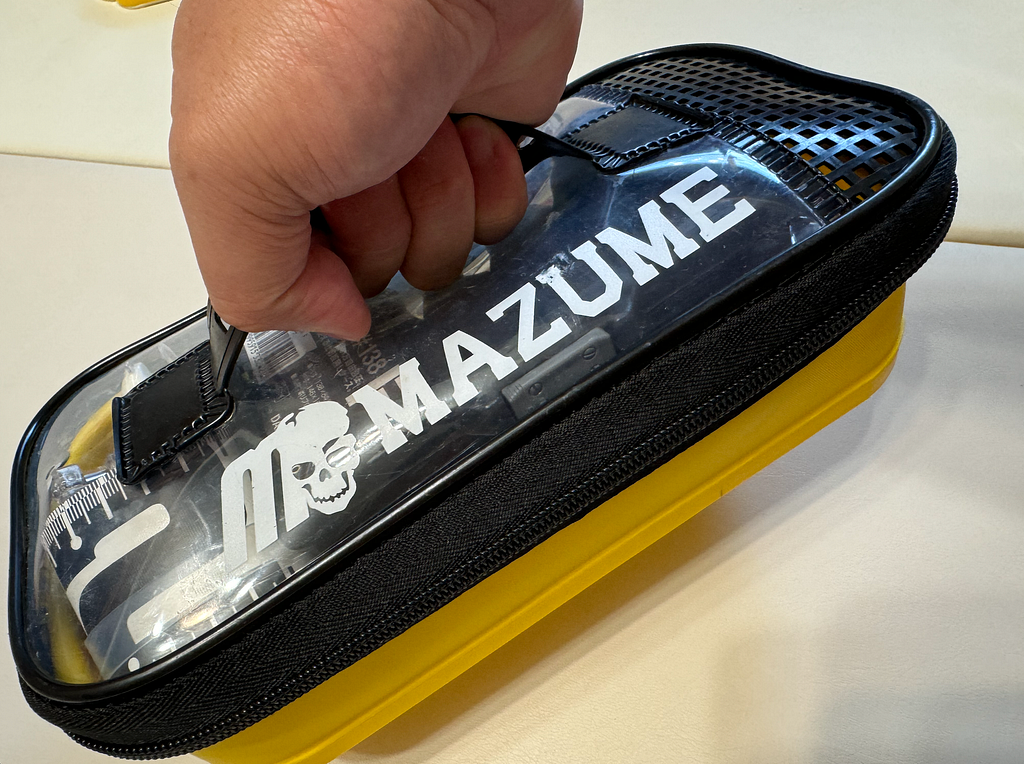
No loss. The main target in both Nagoya and Kanazawa was Japanese seabass — 真鱸. With the target narrowed, the kit could shrink too. A dozen-odd hard baits, ten seabass soft plastics, a small plastic box for snaps and terminal bits, a couple of small metal jigs, a Daiichiseiko measure and a pair of pliers. All of it inside a medium MAZUME soft case. Outside the case: rod sleeve, fish grip, two spools of leader, and a headlamp I’d carry whether I fished or not. That was the lot, and it barely dented a 29-inch suitcase.
Rod, reel and line:
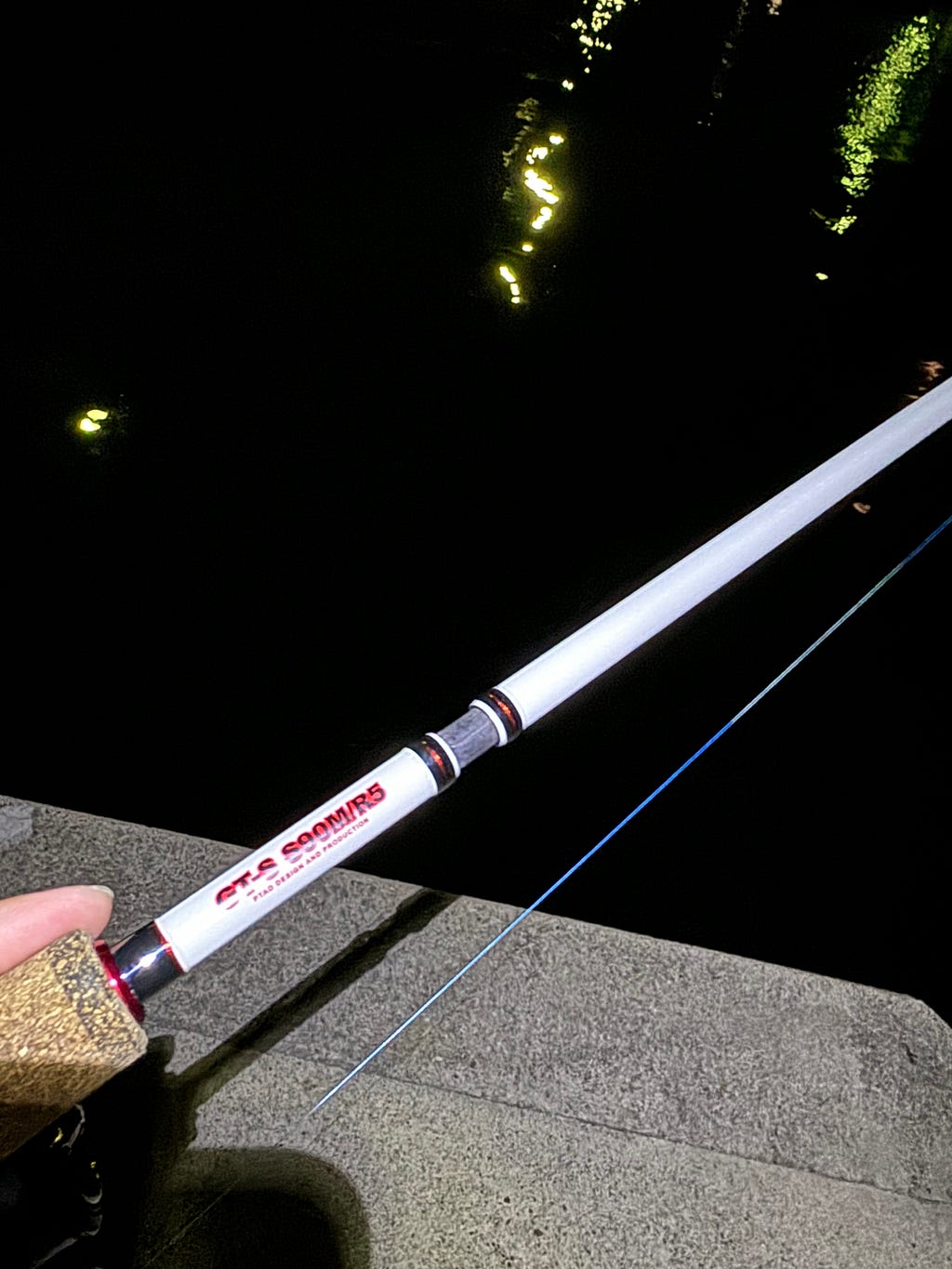
Rod: PTAD GT-S S90M/R5 Reel: Shimano Stradic C3000HG Line: Sunline #1, carbon #4
I have to give this travel rod from A-di in Pingtung its due — the PTAD GT-S S90M/R5. Weight, strength, feel, it’s near the top in all of them. Early on I put it straight up against an 80-something-cm Hawaiian ladyfish and it handled the fight without drama. Light enough to work micro jigs all day without fatigue. It’s built as a seabass rod, but the sensitivity holds up enough that you don’t lose much when you fish slow, fiddly stuff for bottom species. I’ve never had much love for the word “versatile” — but for a rod like this, I don’t have a better word for how well it adapts across saltwater spots and methods. To be clear: this time versatile is a compliment, not the kind of jack-of-all-trades that always feels like it’s missing something.
On packing length — the thing every international traveller frets over — the rod, wrapped in a neoprene buffer sleeve, goes into the 29-inch case without even sitting on the diagonal. Stood vertical, there’s room above and below. I lay it dead centre and pack clothes either side to brace it. A 27-inch case just takes it on the diagonal. No hard tube, no extra baggage hassle through the airport, and a high-quality seabass rod travels with you.
Intel
Confession first: I didn’t do much homework this time. My fishing buddy T-san lives in Nagoya, so I just leaned on him. Beforehand I only flipped through the Anglers SNS app — the Nagoya scouting pointed to the Tenpaku River mouth, and for Kanazawa I locked onto two river mouths near the city.
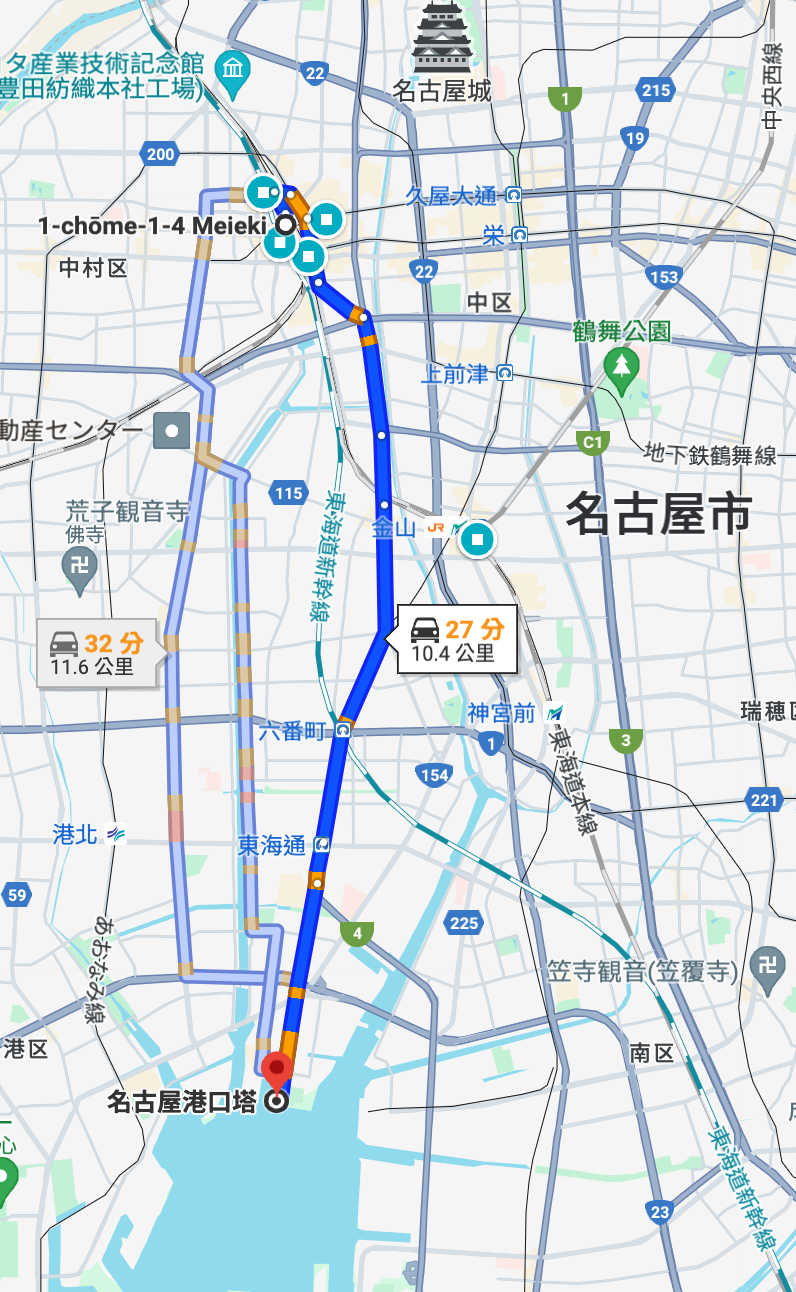
Four nights in Nagoya split across the start and end of the trip, one night in Kanazawa. The Nagoya lodging sat by the station — about ten kilometres from the nearest coast, half an hour’s drive. Not close, but fishing was never the spine of this trip, and the stay was chosen for living and transport convenience.
The trip
Day one, by the time we’d settled into the hotel it was dinner. After a full day on the road I just wanted to rest — though looking back, that may have been the best window I had in Nagoya. Shame (not really).
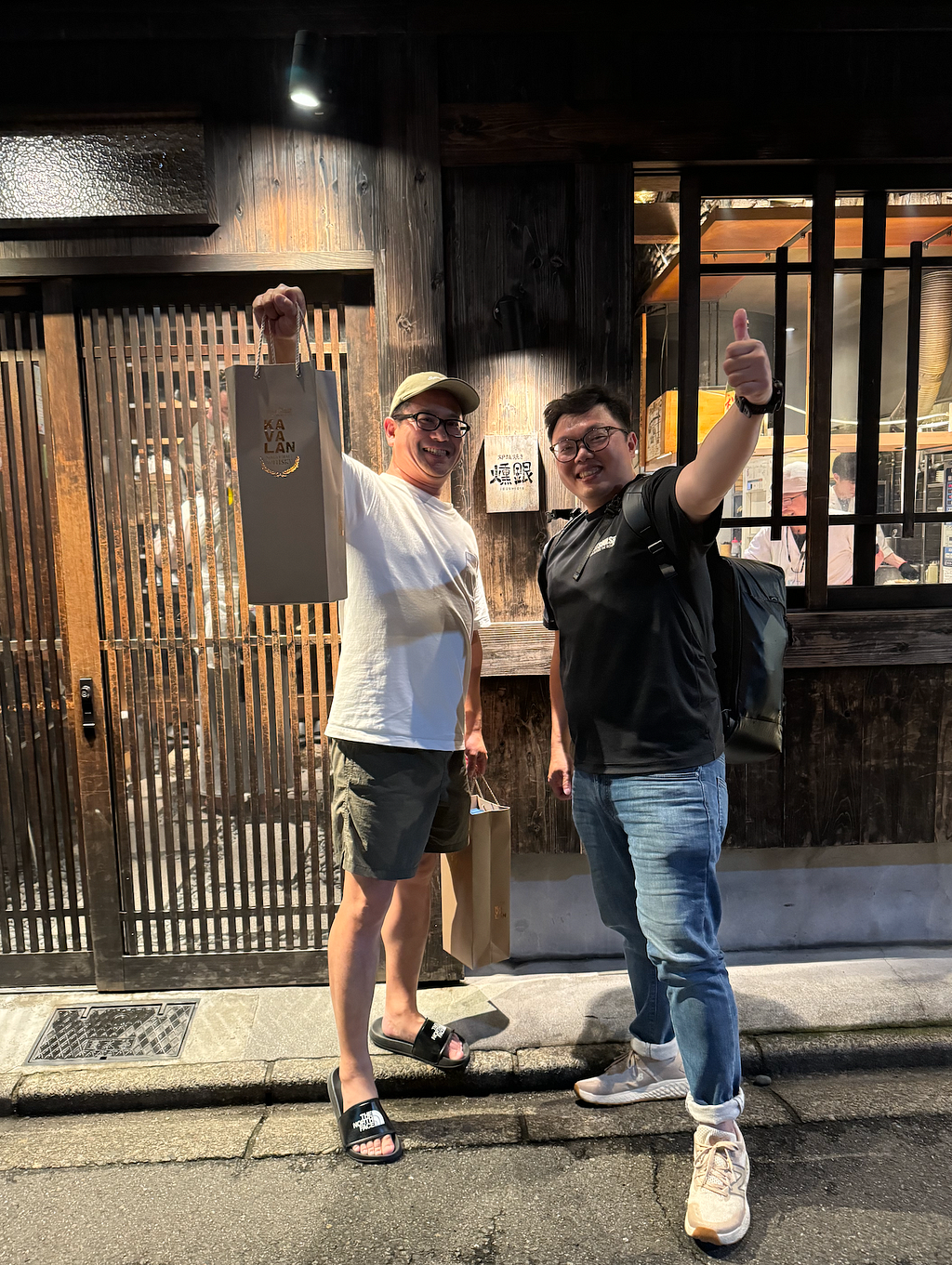
Second night, T-san and I both brought family for a meal. The last time we’d met was almost exactly a year back, and seeing him again I couldn’t keep a straight face from happiness. He ordered a grilled kichiji and went over the top spending on us. But my daughter hit bedtime and started fussing, so the meal ran short — and with drinks at the table, no driving after, so no fishing that night either. We agreed to meet again the next weekend when I’d loop back through Nagoya.
Next day we left for Takayama, Hida-beef country. Hida beef isn’t one of the three famous wagyu brands everyone names, but it’s renowned all the same, and you eat it properly when you’re there.
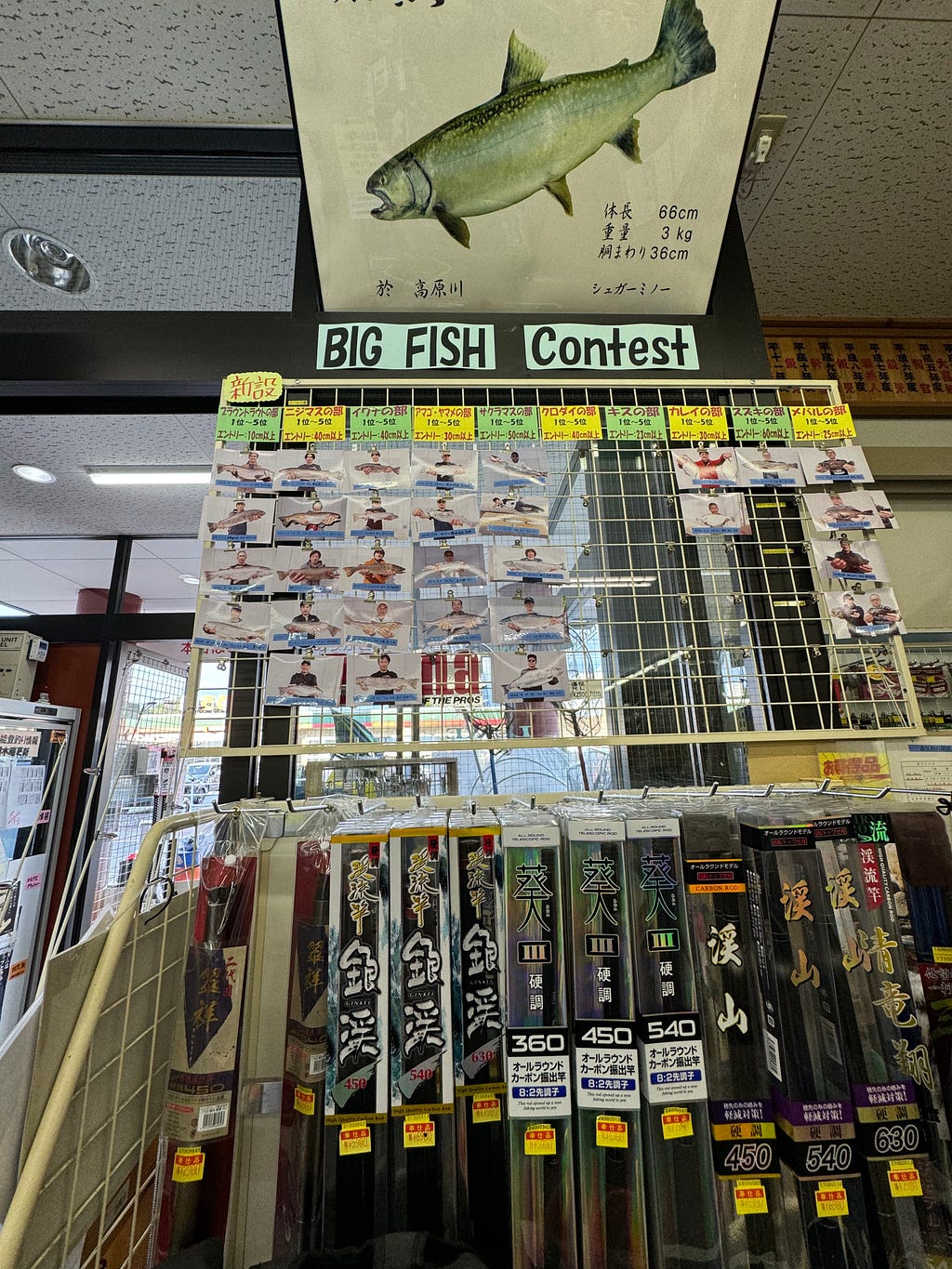
Takayama sits inland — the fishing here runs to trout, salmon and sweetfish. I found a tackle shop to browse in a gap. It carried saltwater gear too, but trout product dominated: small wild-water pencils and minnows, trout-pond specialist lures filling over three full shelf faces, plus fly gear and even refrigerated stream insects for sale (no more flipping rocks yourself).
What caught my eye were the older, traditional pieces. First, snowshoes — the wooden kind I’d seen years ago in a fishing manga, strapped under regular boots, the oversized frame spreading contact area so the wearer doesn’t sink into the snow. Second, a traditional sweetfish method called ayu shakuri — not really angling, closer to a snagging technique like the fish-spearing you see in Taiwan’s mountains. I picked up two different hook styles as souvenirs of a fishing tradition I’d never seen before.
From Takayama we drove through Kamikochi and Shirakawa-go before landing in Kanazawa. Kamikochi surprised me — the Azusa River against the alpine backdrop genuinely felt like the European Alps. Highly recommended even if fishing isn’t on the agenda.
A window finally opened
Evening of June 20th. We arrived at the Nikko Hotel in Kanazawa — bigger room than expected, enormous bathroom, TV built into the bathtub. My wife had booked it for roughly NT$3,300. I told her she was a genius.
My daughter had run herself ragged at the gassho village and fell asleep fast. Bottles washed, it was only 9:30. Car parked downstairs. I had legs. I asked my wife for clearance and got it. Father’s night out, Kanazawa edition.
I hadn’t planned this session in any detail, so I had no precise spot ready. Ten minutes scrolling the Anglers SNS app pointed me to the area around Ono Odaiba Park. One pass on Google Maps Street View sealed it: a parking lot packed with fishing uncles. Close enough.
Finding the mark
Twenty minutes later I was there. Kit rigged up, sea in front of me, a light breeze, the far bank lights playing on the water. The uncles were soaking bait and poking rods into the bottom — looked like eel fishing. Upstream rain had coloured the water, which probably suited them fine.
I threw a few casts at the edge of their light and moved on toward the mouth. Found a couple of lure anglers working the water, all blanking.
Around 23:45 I sat down with the chart. The Ono area is actually a small island sitting in a wide river channel. The main flow runs four to five metres deep — too open, no obvious ambush point. But at the island’s southwest corner there was a shelf: deep water dropping sharply into two to three metres, with a bridge sitting right over it. Bridge light draws baitfish. The depth change gives a predator somewhere to hold. That combination was worth a look.
On the fishing report app I found a post from the previous evening — someone had caught near here. I can’t read Japanese, but I can puzzle out kanji well enough: low tide bottom, bridge pillar, careful of oyster shell snags. I didn’t know which bridge, but looking at the chart the southernmost one seemed the best call. I checked the tide table. Low tide at 23:30. Right now. I started walking.
56 centimetres — a Hokuriku seabass
At the bridge I climbed up for a look first. The south bank had the best water but was fenced off with no-entry signs. Japan fishing rule number one: respect the signs, find another way in. The north side had a minor tributary coming in on the left and a marina basin behind a fence on the right. The far right corner of the north bank looked accessible. I circled through a residential side street, found a dead-end alley, and at the end of it — a path down to the water.
The spot had everything: bridge pillar, light, a deep-to-shallow transition, even a small drainage outfall. On the first casts I felt the lure grinding across oyster shell at around 0.5–1.5 metres depth, confirming the structure from the report. Right place.
Just after midnight I’d mapped the bottom well enough to know where to lift the rod. On one pass, maybe three metres before the shelf, I felt resistance — too early for the structure. Then a headshake.
Fish on.
It ran hard toward the oyster bed. I locked down and turned it before it could reach the shell and cut me off. When it couldn’t go deep it switched to gill-rattling — the swivels inside the lure clicking as it threw its head. I kept the tip low and tried to kill the jumps. I hit record on the GoPro. The first thirty seconds are pitch black — I didn’t dare switch on the headlamp in case the light panicked it into one more run. Keep the sound on.
When the runs finally shortened I switched on the light and brought it to the bank. Last-ditch charges, then it came up. I saw about thirty centimetres of white belly, thought manageable — loaded the rod to swing it up. Heavier than expected.
On the bank: 56 centimetres. Hokuriku seabass. Got you.
I released it. My hands were still shaking when I sent the message home.
After a rest I kept at it. Snagged a crab next — diverse species count on this session. Another forty-odd minutes, another take — this one jumped hard and came back clean. Lure gone, line slack. The legendary gill-slash. It was late, I had the 56 in the bank, and tomorrow was an early start. I reeled in and walked back.
Back to Nagoya
Friday: the train home from Kanazawa. I missed two connections in a row and arrived in Nagoya already hollow. T-san and I had fishing plans for the weekend but that night I just went to bed.
Saturday: rain from dark to dark. The Nagoya seabass session was off. T-san and I agreed to save it for next time.
Rain end to end — the Nagoya session was off, and T-san and I agreed to hold it for next time. But Kanazawa had already made the trip. I went to Japan to catch a seabass between nap times, and on a Tuesday night at low tide under a bridge in Hokuriku, it happened. These windows don’t follow a schedule — when one opens, you go. Full marks.